Growth is usually easy to recognise. More customers. More employees. More transactions. More locations. More revenue.
But there is another side of growth businesses do not always prepare for: the systems behind the business need to grow too.
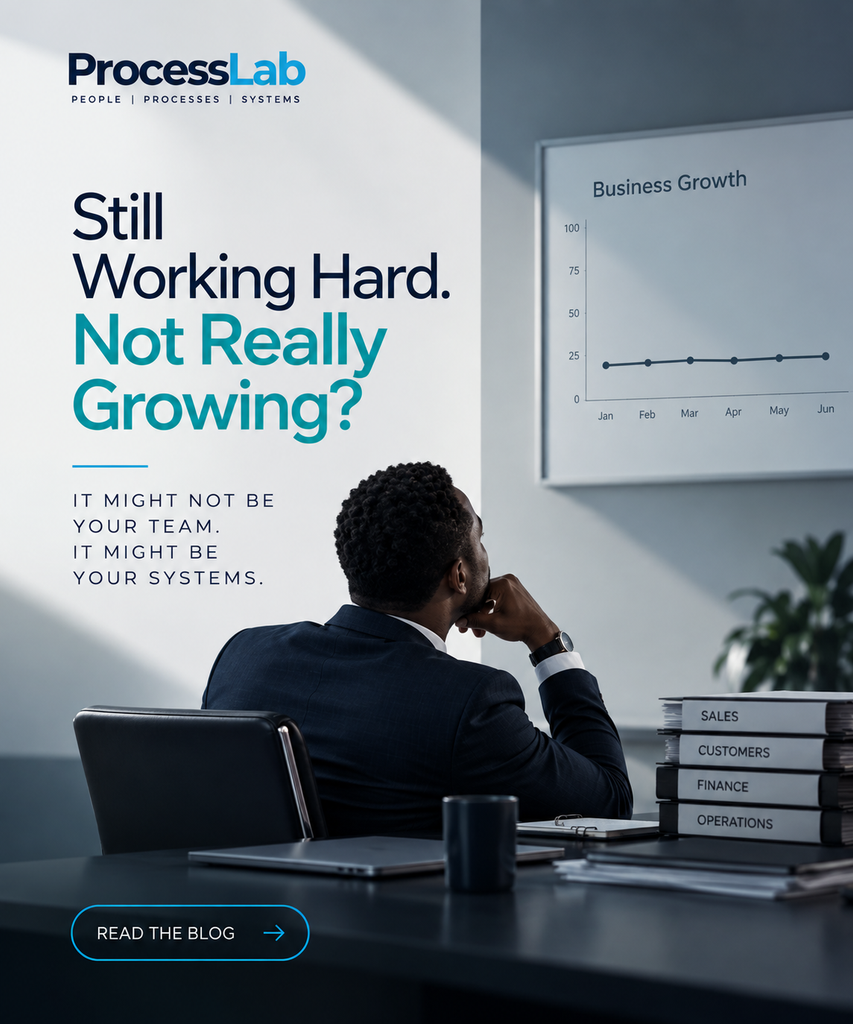
The spreadsheet that worked perfectly when you had five employees becomes several spreadsheets when you have thirty. Customer information starts living across emails, WhatsApp conversations, individual laptops and different departments. Approvals take longer. Reporting becomes harder. Managers spend more time asking for updates, and somehow, the business owner is still involved in decisions the team should be able to make independently.
The business has grown. The systems behind it have not.
When this happens, growth can begin to create complexity instead of capacity. And the warning signs often appear long before the business recognises that it has a systems problem.
Information Is Becoming Harder to Find
Where is the latest customer information? Who followed up on that lead? Has the invoice been sent? Which version of the report is correct?
If these questions are becoming part of everyday work, your team may be spending too much time looking for information that should already be available to them.
As organisations grow, information naturally increases. More customers create more records. More employees create more communication. More transactions create more data. Without a central system for managing that information, employees begin creating their own ways of keeping track.
Sales has one spreadsheet. Finance has another. Customer service has the WhatsApp conversation. Someone has an important document saved on a laptop. Management receives yet another report.
Everyone may be working with information about the same business, but nobody has the complete picture.
At that point, the challenge is no longer simply organisation. It is visibility.
Your Business Depends Too Much on Certain People
Every business has employees whose experience and knowledge are valuable. The problem begins when essential processes cannot move without them.
If one employee goes on leave and nobody knows where a document is, what stage a customer request has reached or how a particular process works, important business knowledge may be living in people’s heads instead of within the organisation.
The same can happen with founders and senior managers.
If routine approvals, customer decisions, task assignments and operational questions still need to reach the CEO, growth has not created independence. It has simply increased the number of things competing for one person’s attention.
A scalable business should be able to distribute responsibility without losing visibility. People should know what they own, what happens next and where to find the information required to do their jobs.
The goal is not to make people less important. It is to ensure that the organisation does not become dependent on one person’s memory, inbox or availability.
Spreadsheets Are Becoming Your Business Infrastructure
There is nothing wrong with spreadsheets. They remain incredibly useful business tools.
The warning sign is when they begin holding the entire organisation together.
One spreadsheet tracks leads. Another contains customer information. Another monitors invoices. Another tracks projects. Another manages inventory. Then someone downloads a copy, someone else updates an older version, and eventually a meeting begins with a familiar question:
“Which one is the updated file?”
At that point, the business does not need another spreadsheet. It needs a more connected way of working.
The bigger the organisation becomes, the more expensive fragmented information can be. Teams duplicate work, reporting becomes slower and leaders may make decisions using information that is already outdated.
Growth requires a reliable source of business information that teams can access without repeatedly reconciling different versions of the truth.
Approvals and Follow-Ups Are Slowing Everything Down
“Please approve.”
“Just following up.”
“Bringing this back to the top of your inbox.”
These messages may appear harmless, but when they become the mechanism keeping everyday operations moving, they reveal something important about the underlying process.
A workflow that depends on someone remembering to send a message, check an email or chase an approval will become increasingly difficult to manage as transaction volumes grow.
The solution is not necessarily to ask people to follow up more aggressively.
The process itself may need to change.
Clear workflows can define who receives a request, who approves it, what happens next and how everyone involved can see its status. Automation can then remove repetitive follow-ups and allow employees to focus on work that genuinely requires their attention.
The objective is not to remove people from the process. It is to remove unnecessary friction from their work.
Reporting Is Becoming a Project of Its Own
Management asks what should be a simple question:
“How did we perform this month?”
Suddenly, several people need to open spreadsheets, request updates, reconcile figures and prepare another report to explain what happened.
By the time the information reaches management, the business may already have moved on.
This is one of the clearest signs that an organisation has outgrown its systems.
Leaders need timely visibility into what is happening across sales, finance, operations, customer activity and other important areas of the business. When obtaining that visibility requires days of manual work, decision-making becomes reactive.
Connected systems can give leaders a clearer and more current view of performance, allowing them to spend less time gathering information and more time deciding what to do with it.
Your Customers Are Beginning to Experience the Gaps
Internal inefficiencies rarely remain internal.
Eventually, customers experience them.
A salesperson makes a promise that operations does not know about. A customer explains the same issue to three different employees. A follow-up is missed because everyone assumed somebody else had handled it. An invoice takes too long to arrive. A request disappears inside an email thread.
These incidents may look like individual customer service failures, but repeated occurrences often point to something deeper: disconnected processes behind the scenes.
Customers do not see your internal systems. They experience the results of them.
A well-designed system helps teams share information, understand ownership and maintain continuity throughout the customer journey. That consistency becomes increasingly important as the number of customers, employees and interactions grows.
Hiring More People May Not Solve the Problem
When workloads increase, hiring more people often feels like the obvious solution.
Sometimes, it is.
But adding more employees to an inefficient process can simply create a larger inefficient process.
Before increasing headcount, businesses should ask a different question: Is the problem really a lack of people, or is the way we work creating unnecessary work?
Manual data entry, duplicated information, repetitive reporting, constant follow-ups and unclear approval processes all consume employee time. If those inefficiencies are not addressed first, additional employees may simply inherit them.
Better processes, supported by the right technology, can help existing teams work more effectively and allow new employees to enter an organisation that is already structured for growth.
Growth Needs Better Infrastructure
The systems that helped you start your business are not necessarily the systems that will help you scale it.
That is not a failure. It is often simply evidence that the organisation has reached a new stage.
The real risk is continuing to operate a larger business with processes designed for a much smaller one.
Technology can help, but technology alone is not the answer.
Buying software without understanding the process underneath it can simply digitise the same inefficiencies.
Before automating a process, you need to understand it.
Where does work slow down? Where is information duplicated? Who owns each decision? Which tasks are unnecessarily manual? What should be eliminated, simplified or standardised before technology is introduced?
Those questions should come before the software.
Build Systems That Can Grow With You
An integrated business platform such as Zoho can help connect areas such as customer relationship management, finance, projects, analytics, collaboration and other business functions.
But successful implementation is not about activating as many applications as possible.
It is about designing a system around how the organisation needs to operate.
At ProcessLab, we help businesses examine how work currently moves through their organisation, identify bottlenecks and opportunities for improvement, and then design and implement Zoho-powered systems that support their operations and growth.
We do not believe the goal should be more software.
The goal is a better-run business.
A business where information is easier to find. Where responsibilities are clearer. Where leaders have greater visibility. Where teams spend less time chasing updates. And where growth does not automatically create more complexity.
Your business may already be growing.
The question is whether your systems are ready to grow with it.
Ready to build a business that works better as it grows? Talk to ProcessLab.
