
Every business owner wants growth. More customers, more revenue, a bigger team, new locations. These are the wins you work toward, and they deserve to be celebrated.
But growth has a habit of exposing cracks that never showed up when the business was small. The one spreadsheet that used to hold everything turns into five spreadsheets owned by five different people. Customer conversations spread across WhatsApp, email and personal phones. Approvals slow down. Managers spend their day chasing updates instead of making decisions. And somehow, even with a bigger team, the founder is still the one everyone waits on.
When this happens, growth isn’t really the problem. The way the business works is.
Small Business Habits Don’t Scale on Their Own
Most companies start with informal systems, and there’s nothing wrong with that in the early days. A team of five can run on memory, WhatsApp and good intentions because everyone can see everyone else’s work. The founder knows the customers by name. An approval is just a conversation away.
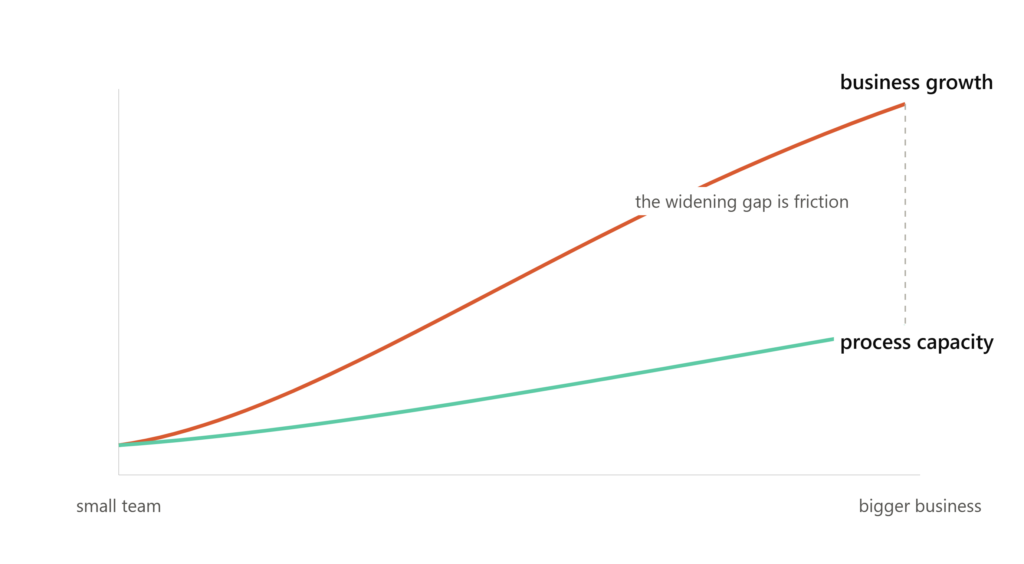
That approach breaks down as the business grows. Ten customers become a hundred. Five staff become thirty. The number of enquiries, approvals and transactions multiplies, but the underlying systems often stay exactly the same as they were on day one.
So the real measure of growth isn’t just revenue or headcount. It’s whether the way you work can keep up with the business you’re becoming.
The Problem Usually Isn’t Your People
It’s tempting to blame an employee when something slips. Why didn’t they follow up? Why was the invoice late? Sometimes that’s fair. But often, good employees are stuck working inside processes that make good work difficult.
Picture a salesperson tracking forty prospects with nothing but memory and a WhatsApp thread. Something will fall through eventually, not because they’re careless, but because no system is holding the details for them. Or picture a manager asked to make a fast call when the information they need is scattered across three spreadsheets in two departments. The issue isn’t their judgment. It’s that the information never reaches them in a usable form.
The same thing happens when every decision has to pass through the founder. That might work with five employees. With fifty, the founder becomes the bottleneck everyone is stuck waiting behind.
Telling people to try harder doesn’t fix any of this. Hiring more people into a broken process just gives you a bigger version of the same problem.
Trace How Work Actually Flows Through Your Business
Every business runs on processes, whether or not anyone ever wrote them down. A lead comes in. A client signs off on a quote. A staff member submits an expense. Each of these has to move from one person or stage to the next, and how smoothly that happens says a lot about how the business is really doing.
Who owns each step? What information do they need, and where does it currently live? Who has to sign off before it moves forward? What happens if the person responsible is out sick?
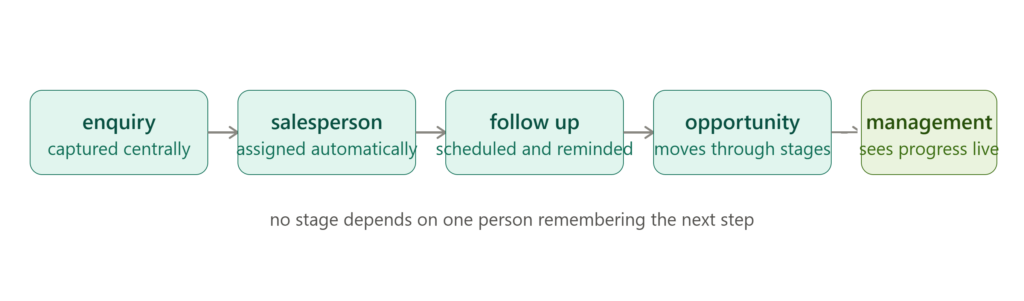
When the answers are clear, work moves without friction. Employees know what’s expected, customers get a consistent experience, and leadership can see what’s happening without asking. When the answers are fuzzy, people fill the gaps themselves. Tasks get duplicated, follow ups get forgotten, and two customers calling about the same issue can walk away with two completely different experiences.
This is what process improvement is actually for. It’s not about pushing people to move faster. It’s about giving the business a clearer, more dependable way to operate.
Fix the Process Before You Buy the Software
When things start feeling chaotic, the first instinct is usually to shop for a tool: a CRM, an ERP, some kind of automation platform. But buying software isn’t the same thing as fixing how the business runs.
Before asking what tool to buy, it’s worth asking a more basic question: how should this process actually work? Automating a messy process just means the mess happens faster. Dropping unclear responsibilities into a shiny new system doesn’t make anyone accountable. It just moves the confusion online.
Real transformation starts by looking closely at the business itself: mapping the current process, finding where it breaks down, deciding who owns what, and agreeing on what information actually needs to be captured. Technology comes after that groundwork, not before it.
Don’t automate confusion. Fix the process first, then build the system around it.
People, Process, Technology and Data Have to Work Together
Lasting change happens when four things line up. People need to know what they’re responsible for and have access to the information that job requires. Processes need to define how work actually moves and who is accountable at each step. Technology should cut down on repetitive tasks and connect information across the business. Data should give leadership a clear enough view to make good decisions without having to ask around.
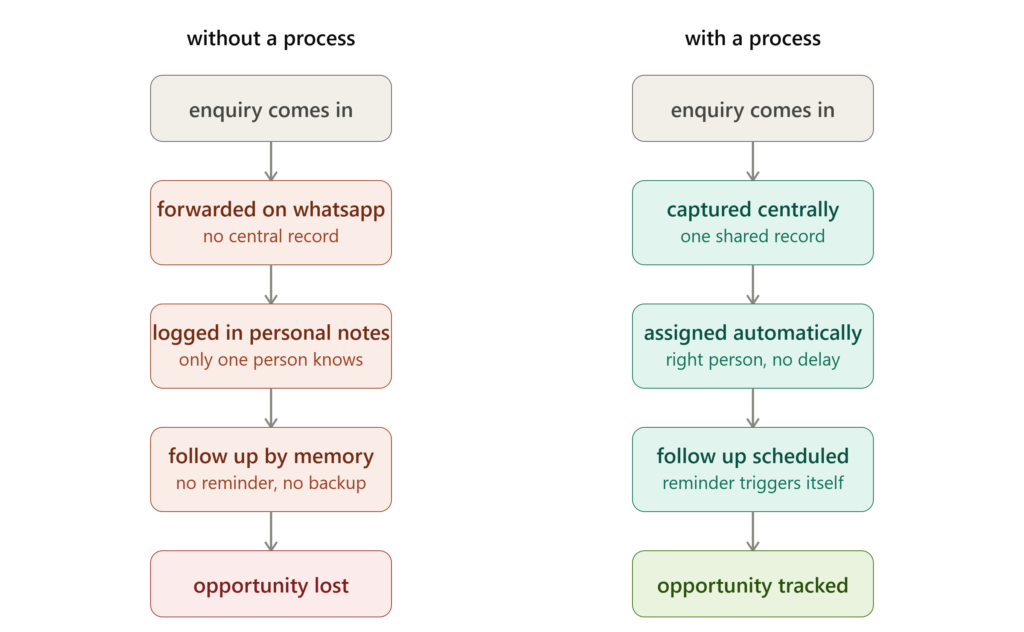
Think about a new customer enquiry in a business without any of this in place. It comes in through WhatsApp, gets forwarded to a salesperson, gets jotted down somewhere, and management has no visibility into what happens next. If that salesperson forgets to follow up, or leaves the company, the opportunity often disappears with them.
Now picture that same enquiry moving through a business with a real process behind it. The customer’s details are logged in one place. The right salesperson is assigned automatically. Follow ups are scheduled and reminders go out on their own. Leadership can see exactly where things stand without chasing anyone for an update.
The people in the second business aren’t working harder. They’re working inside a system that was actually built to support them.
Your Business Shouldn’t Fall Apart When Someone Leaves
Here’s a simple test. If one of your key people resigned tomorrow, would their customer relationships go with them? Would someone have to dig through old email threads just to understand what was in progress? Would the new hire have to lean on colleagues to explain everything the last person quietly knew?
If you’re nodding along, too much of what keeps your business running lives in individual people’s heads instead of in the business itself. Good processes don’t make people less valuable. They protect the business from depending entirely on any one person’s memory, and they free your team to spend less time hunting for information and more time doing work that actually matters.
As You Grow, Leadership Needs to Step Back From the Details
In the early days, founders touch everything. They’re closing sales, approving expenses, handling complaints and making dozens of small calls a day. That kind of hands on involvement often makes sense when the business is young.
But if a thirty person company still needs the founder to keep the wheels turning, the business has gotten bigger without actually maturing. Strong processes change that. They make it clear what the team can handle on its own, what genuinely needs sign off, and what can run without anyone touching it at all. That’s what gives leadership the room to focus on strategy instead of getting pulled into problems a good system would have caught on its own.
Ask Yourself Whether Your Business Has Outgrown How It Works
You don’t need a crisis to justify a closer look. The signs tend to show up quietly first. Information scattered across five different spreadsheets and inboxes. Staff constantly asking each other for basic answers. Follow ups that depend entirely on someone remembering. The same data typed into two different systems. Simple approvals that still somehow need the founder’s attention. A performance update that takes three days to pull together.
On their own, these look like small annoyances. Add them up and they get expensive fast, in wasted hours, missed opportunities, frustrated staff and a business that finds every new stage of growth harder to manage than the last.
None of this means automating every single thing. Not every conversation needs to become a workflow. Not every decision belongs to software. Good judgment still matters, and no system should replace it where it genuinely adds value. The real goal is simpler: a business where people can find what they need, know what they’re responsible for, and keep growing without descending into chaos.
The real question was never whether your business can grow. It’s whether the way it works can grow along with it.
Ready to Take a Closer Look at Your Processes?
If your operations are starting to strain under your own growth, the answer usually isn’t another hire or another piece of software. It’s understanding exactly where the friction is coming from.
Book a free process review with ProcessLab. We’ll walk through how your business actually runs today, point out where it’s quietly costing you time and opportunities, and show you exactly where the fix belongs, whether that’s your process, your people or your technology.
Book a FREE Consultation here: www.processlabng.com
